

In my last article, I described my time in Wyoming, and my recent trip to the battlefield at Fort Phil Kearny. The battle there was a tremendous victory for Chief Red Cloud in a two-year war in which the Indians were victorious. The U.S. defeat ultimately forced the United States to enter into a treaty regarding ownership of the lands encompassing the Bozeman Trail, which included hunting grounds contested and used by Lakota, Cheyenne, Arapaho and Crow peoples. It was not long before the U.S. broke this treaty.
Generally speaking, the Indians objected to the United States Army marching into their country, taking their land, and continually breaking their promises. People who have lived somewhere for generations tend to object when strangers arrive and take their land, try to force them onto other lands they have designated for them, and then claim that the whole business is for their own good. This concept seemed like a somewhat uncomplicated matter to me.
Yet, one reader wrote that the Indians were better off thanks to the white intervention. In all my naïveté I had not thought of that. I should have known that barging into a land, slaughtering a people’s sacred animal by the millions, cutting out their tongues so rich people in New York can enjoy the delicacy—and then leaving the carcasses to rot all over the open plains was actually a good thing.
The Indians, as it was explained, did not realize that the destruction of their entire civilization was actually for their own good. With respect to our reader, I expect that he would be equally delighted if we arrived at his house tomorrow, confiscated the deed, loaded his family into a wagon for parts unknown and informed the surprised family that this was all in the name of progress. Something tells me that he might have discovered a sudden enthusiasm for property rights.
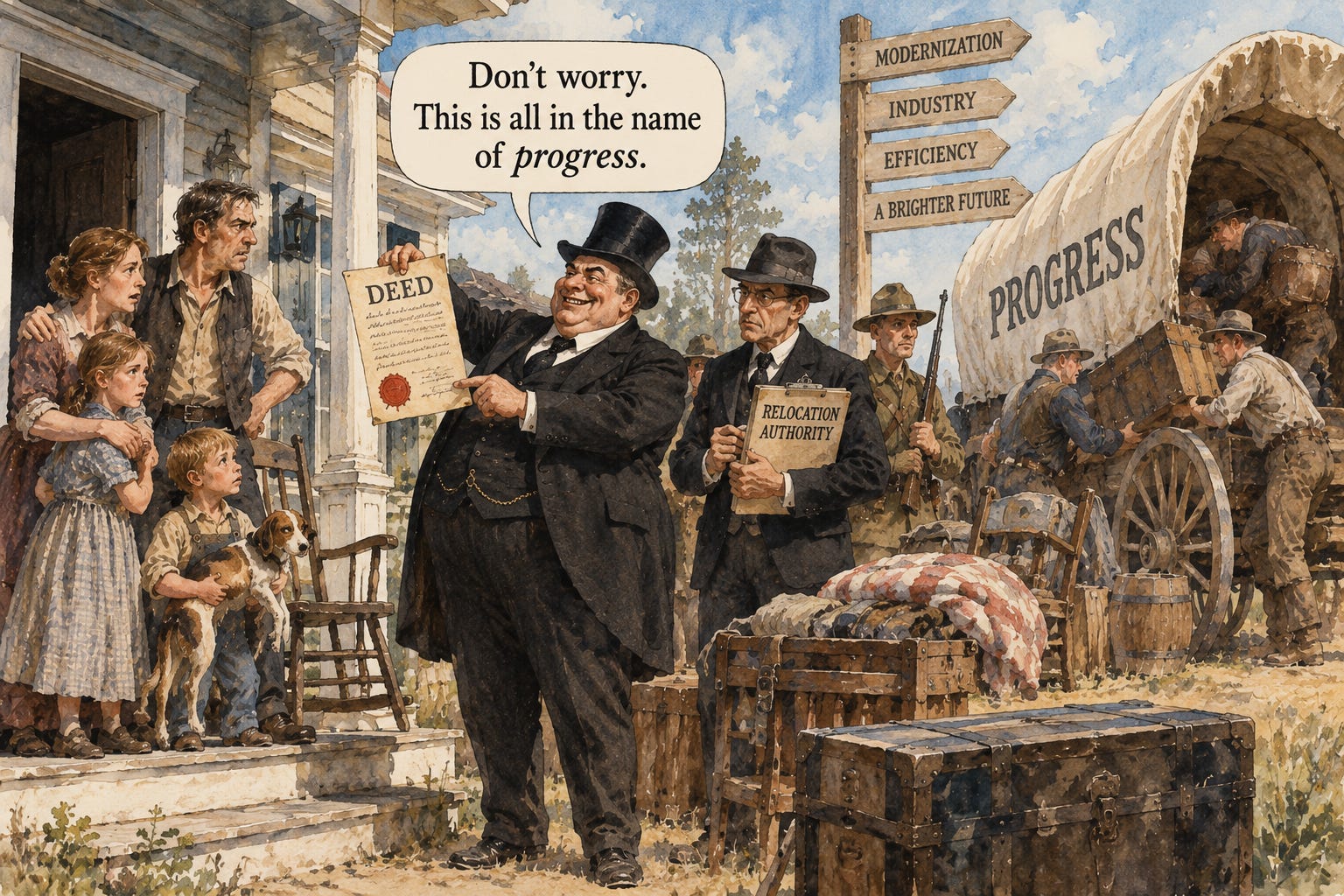
I was tempted to ask him to volunteer for the experiment. If dispossession is such a wonderful gift, why should the Indians or the enslaved Africans have all the fun? Yet I decided to move on and invoke the archaic principle known as the Golden Rule.
But, this exchange bothered me for a reason that goes well beyond one fellow’s opinion on the internet. However disturbing the justification of land seizures and forced relocation may be, it wouldn’t be the first time that someone has justified such a thing based upon the alleged unworthiness of people who happened to hold the land. Europeans had a rather terrific gift for this on their own continent before they came over here and tried it. And the practice continued well into the 20th century, in Armenia, Russia, Germany, and even today in modern day Palestine. Oddly enough, none of the people being slaughtered or relocated seem to like it very much—even if we declare ourselves to be their liberators.
We could run a simple test today in Wyoming, I suppose. A foreign army could march into Wyoming, announce that any previous understandings were no longer convenient, and tell the ranchers to clear out. If the ranchers resist, are they brave Americans defending their homes, or ungrateful savages obstructing progress? Of course it’s absurd. We know perfectly well what we’d call them. We’d write songs about them, name highways after them, and make a twelve-part television series. Yet when the Lakota, Cheyenne, and Arapaho defended their homes, some people suddenly lose the ability to recognize courage.
As a conservative, the reality is that I haven’t changed my beliefs. I still believe private property matters. I still believe a promise ought to mean something. I believe a man has the right to defend his family. And I believe that the teachings of Jesus apply even when the fellow on the receiving end doesn’t look like me, vote like me, or even belong to my tribe. None of this seems especially radical, and I thought that was the whole point. But judging from some of the reactions I have received, I may have wandered into the wrong political party.
Republicans once had leaders who were willing to annoy their own side. Certainly not everyone in Lincoln’s party was on board with his radical views. Theodore Roosevelt went after corporate power and fought to preserve the natural world while plenty of rich, influential Americans wanted to turn every forest into lumber and every river into a balance-sheet entry. The point is that political courage sometimes requires telling your own friends to go to hell.
Eisenhower warned about the military-industrial complex. Goldwater didn’t always wait for permission from the party elders before speaking his mind. Reagan could denounce the Soviet system and still sit down to negotiate with its leaders. Today, too often, a Republican who departs from the approved script by so much as a pinky finger is treated like a deserter under fire. We could blame it on the man at the top. But I think there is plenty of blame to go around.

We Republicans have unfortunately started having pep rallies rather than serious discussions of the country’s problems. We continue to blame the Democrats, but we have been in charge plenty over the last century. At some point, we have to ask ourselves why so many young Americans have been moving over to socialism. Calling them stupid isn’t constructive or fair. I submit that this phenomenon has a lot more to do with the fact that the people governing the country have made ordinary things such as buying a house, raising children, or getting ahead financially out of reach.
Socialism is not the answer. But shouting ‘socialist!’ at a twenty-five-year-old who can’t afford an apartment is not an economic program or in any way helpful. It is not a persuasive argument for capitalism. If the system works so wonderfully, perhaps someone should explain why its supposed beneficiaries are having such a miserable time getting started. And before Republicans congratulate themselves on having all the answers, they might consider whether their own record has contributed to the problem.
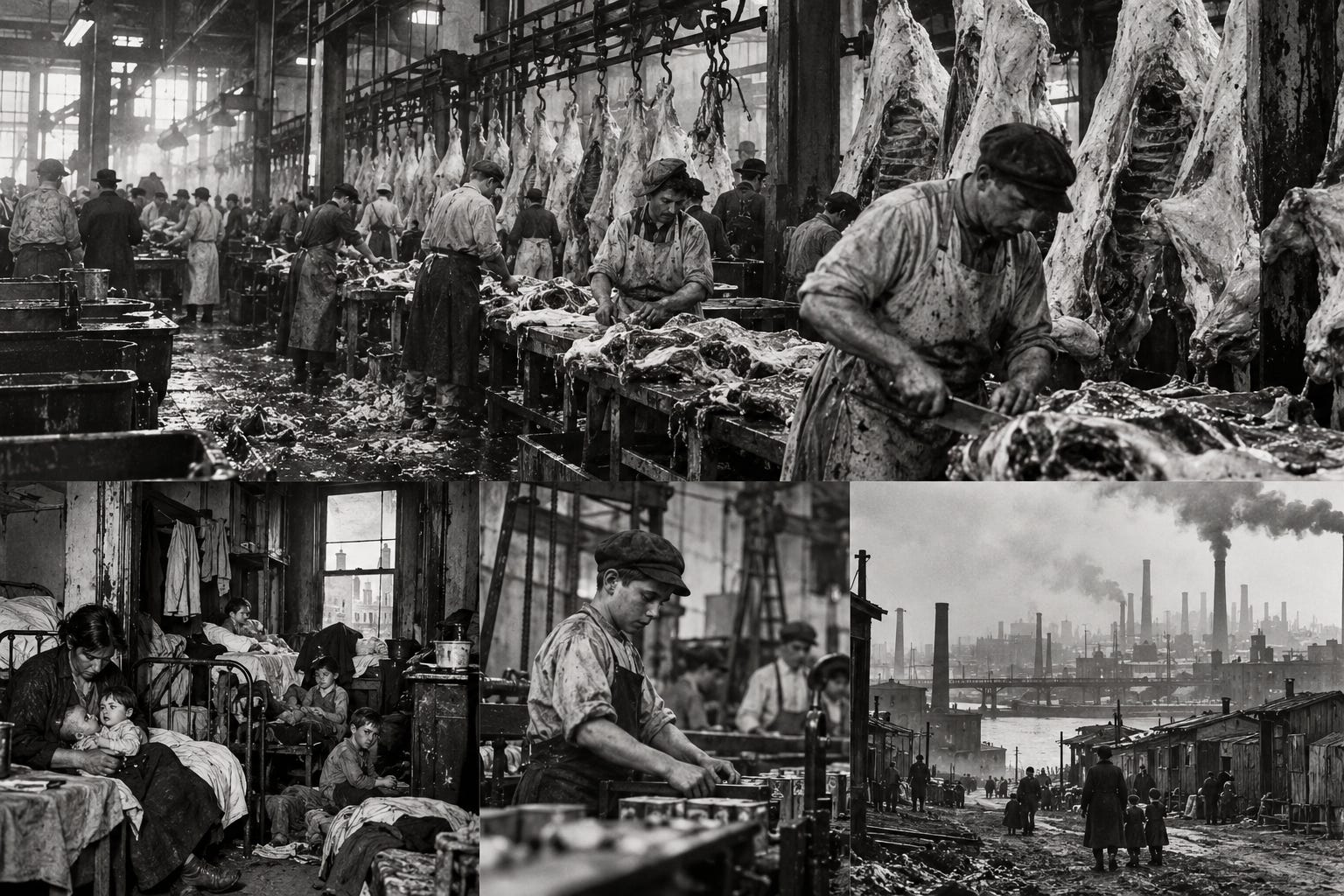
American socialism isn’t anything new. It’s been around since the 19th century. German political refugees, including radicals and future labor organizers, came to America after the failed revolutions of 1848. Later socialist and anarchist movements grew as industrial conditions worsened. They gained greater attention during the industrial age, when Republicans transformed themselves from the party of Lincoln to rich eastern industrialists who would have made Lincoln throw up. Working conditions were dangerous, child labor was widespread, and our agrarian culture of the independent farmer rapidly became an oligarchy that stepped on the heads of the poor. Immigrants were encouraged to migrate and fill up factories and lived lives little better than serfs did back in their home countries.
This was fertile ground for the socialists and anarchists who were complaining about real problems, real issues, and the imposition of a class system that had been the very reason to leave Europe. The Republican Party became the home of the Rockefellers, the Carnegies, and the meatpacking industrialists in Chicago, and railroad tycoons like Pullman. Even then, many workers were sympathetic to capitalism; they just wanted better working conditions and a more fair wage. Unfortunately, many workers had to die in order to win these battles. Writers like the socialist Upton Sinclair wrote The Jungle to expose the horrid conditions endured by workers in Chicago’s meatpacking industry. Socialism took hold in the United States during this time in considerable part because of the naked greed of the industrialists.
Socialist ideas and labor radicalism gained renewed attention during the Depression and found an American voice in the songs of Woody Guthrie and other Depression-era anthems. Hoover’s utter inability to relate to the plight of Americans, and, more importantly, to think of any kind of solution to get food on American tables, further led to disillusionment.
This was illustrated in all its grandeur when the “Bonus Army”—approximately 15,000–20,000 veterans and their families—gathered in Washington demanding early payment of bonuses for their wartime service. They weren’t there for their health. They were unemployed, hungry, and desperate.
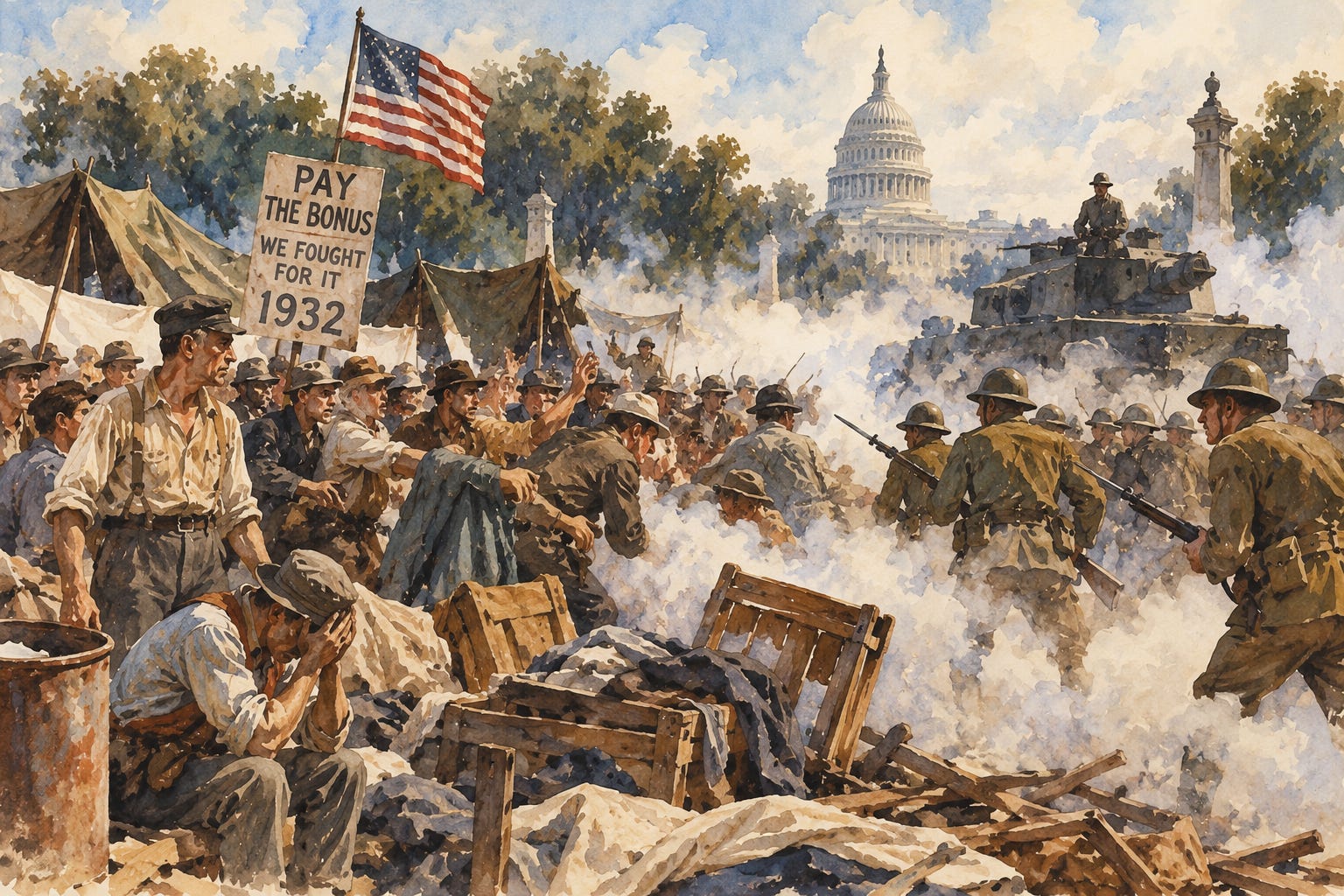
Hoover gave the order on July 28, 1932, to disperse the demonstrators. His general, Douglas MacArthur, did more than that, using cavalry and tanks, as well as tear gas and burning veterans’ encampments. This action hung on the Republicans like an albatross, and rightfully so. Not only did FDR win in a landslide, but being a Republican was about as popular as being a Green Bay Packer fan in Soldier Field. This was not only a heartless act, but politically stupid. Eisenhower, who was on MacArthur’s staff at the time, later made clear that he thought the operation a grave mistake.
Of course, there were rah-rah Republicans out there defending the action. P. Trubee Davison, Hoover’s assistant secretary of war, addressed the New York State convention of the American Legion to merciless heckling. Charles Curtis, the vice president was heckled in Las Vegas, and many newspapers jumped in to support the action. It was actions like these that cost Hoover the presidency—apart from dressing for dinner and eating on the finest china at the White House like royalty while citizens shivered and froze to death on the streets. Other than Eisenhower, who had not yet even announced he was a Republican, there were no doubt Republicans who were horrified over what had happened that day. But the conscientious ones were overshadowed by those that believed that political participation had been reduced to a team sport.
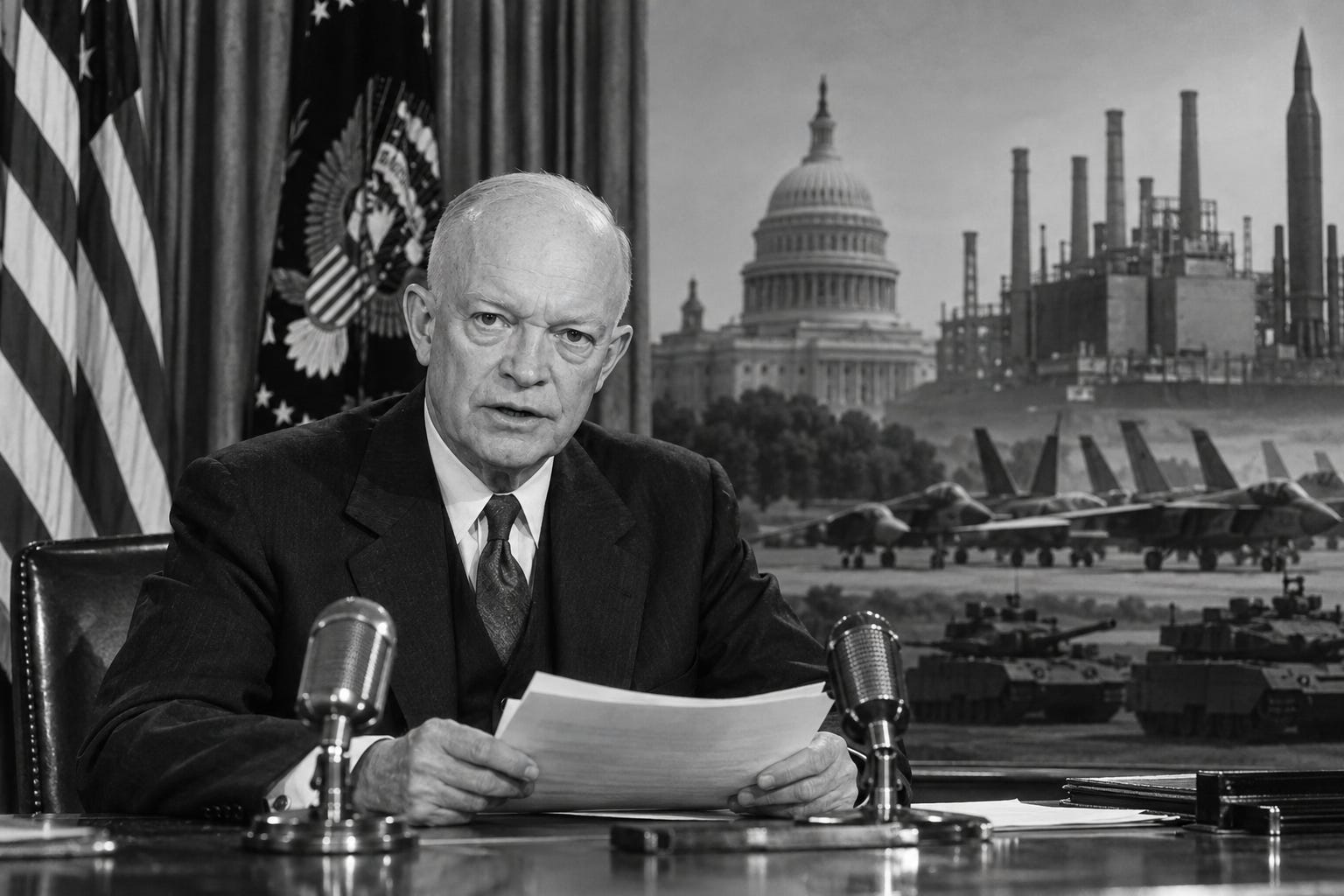
There is another irony in all this. Years later, Eisenhower, a Republican president and the most celebrated American general of his generation, warned his country against the growing influence of the military-industrial complex. Here was a man who knew the Army from the inside telling Americans to be wary of generals, defense contractors, and the political interests surrounding them. He understood that loving the military did not mean giving it a blank check, any more than loving America meant defending every foolish thing its government did.
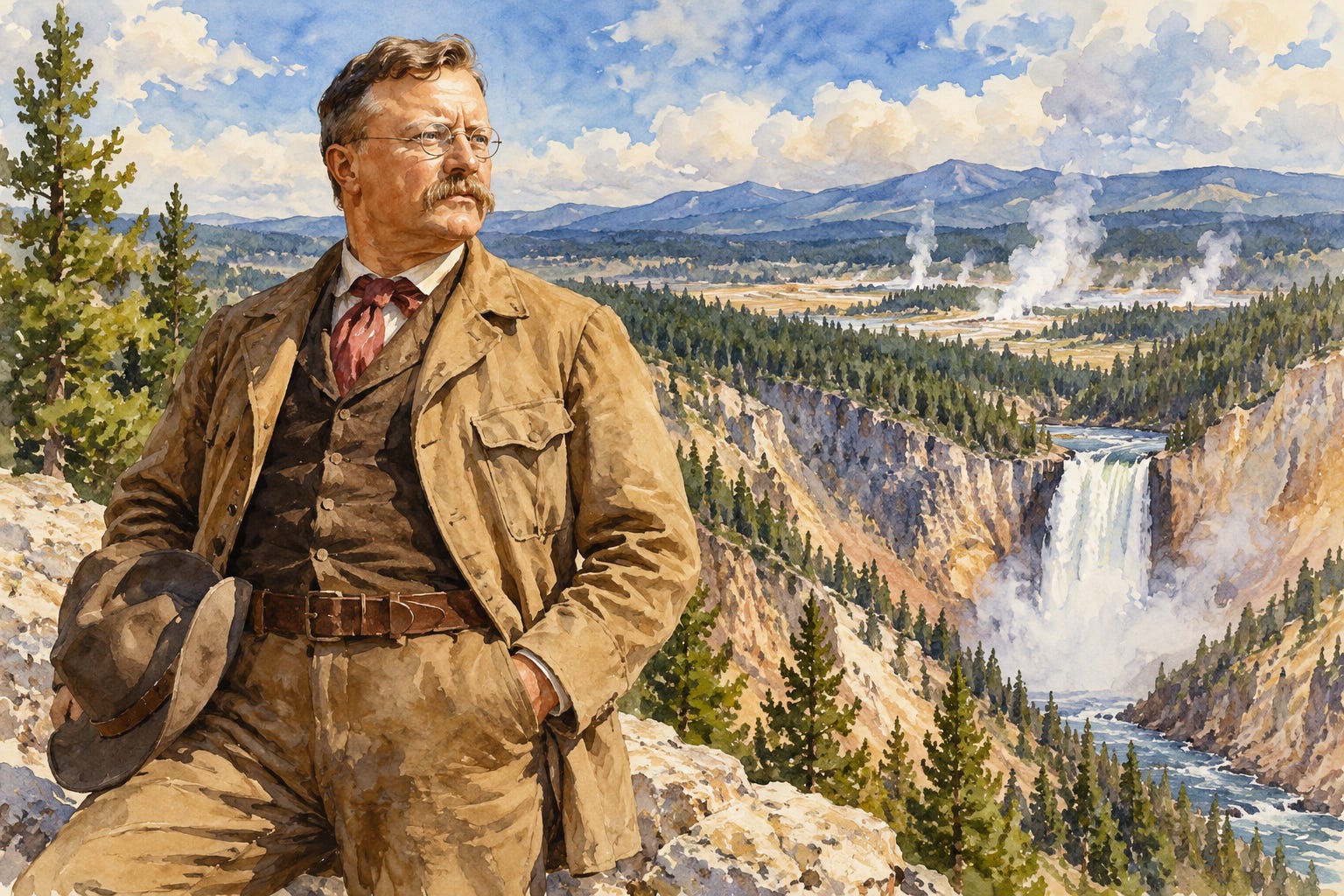
Years earlier, a Republican named Teddy Roosevelt took on the Republican establishment. Teddy was hardly what anyone would call a bleeding-heart liberal. He was a hunter, a rancher, a soldier, who believed that immigrants should assimilate, and that Americans should generally be able to take care of themselves. But he believed that the country belonged to regular Americans, not a handful of wealthy industrialists who regarded the country’s forests, rivers, mountains, and wildlife as commodities for their own personal wealth. The timber barons wanted the forests, the mining companies wanted the minerals, the railroad barons wanted the land, and the cattlemen wanted the public ranges. In years past, these were folks that had gotten pretty much what they wanted from Washington. But Teddy told them no. He helped protect approximately 230 million acres of public land through national forests, wildlife refuges, national monuments, and other measures. He refused to let a handful of donor tycoons make themselves rich by destroying something that belonged to everyone.
This isn’t the Republican Party line anymore. Today Republicans act as though protecting the environment is some sort of communist conspiracy. And everyone just sings along.
Years later there was Phyllis Schlafly, a housewife from Alton, Illinois, who had the gall to believe that she knew more about what was good for American women than the Republican political establishment, the feminist movement, and popular politicians running for President. In the early 1970s the Equal Rights Amendment was sailing through Congress with bipartisan support, and the support of Richard Nixon. Phyllis didn’t care about being unpopular or hurting anyone’s feelings. She believed that the amendment would be a disaster, would undermine protections for women, undermine the traditional family, and subject women to military conscription. She took everyone on and won.
Barry Goldwater had no tolerance for what the Republican establishment thought. He helped create the modern conservative movement. When the religious right began exercising control over Republican politics, he was appalled—and saw all kinds of danger in this for both the Republican Party as well as the churches. He went as far as to defend gay rights in the 1990s—and although I do not agree with his position on abortion, there was room in the Republican Party for his position.
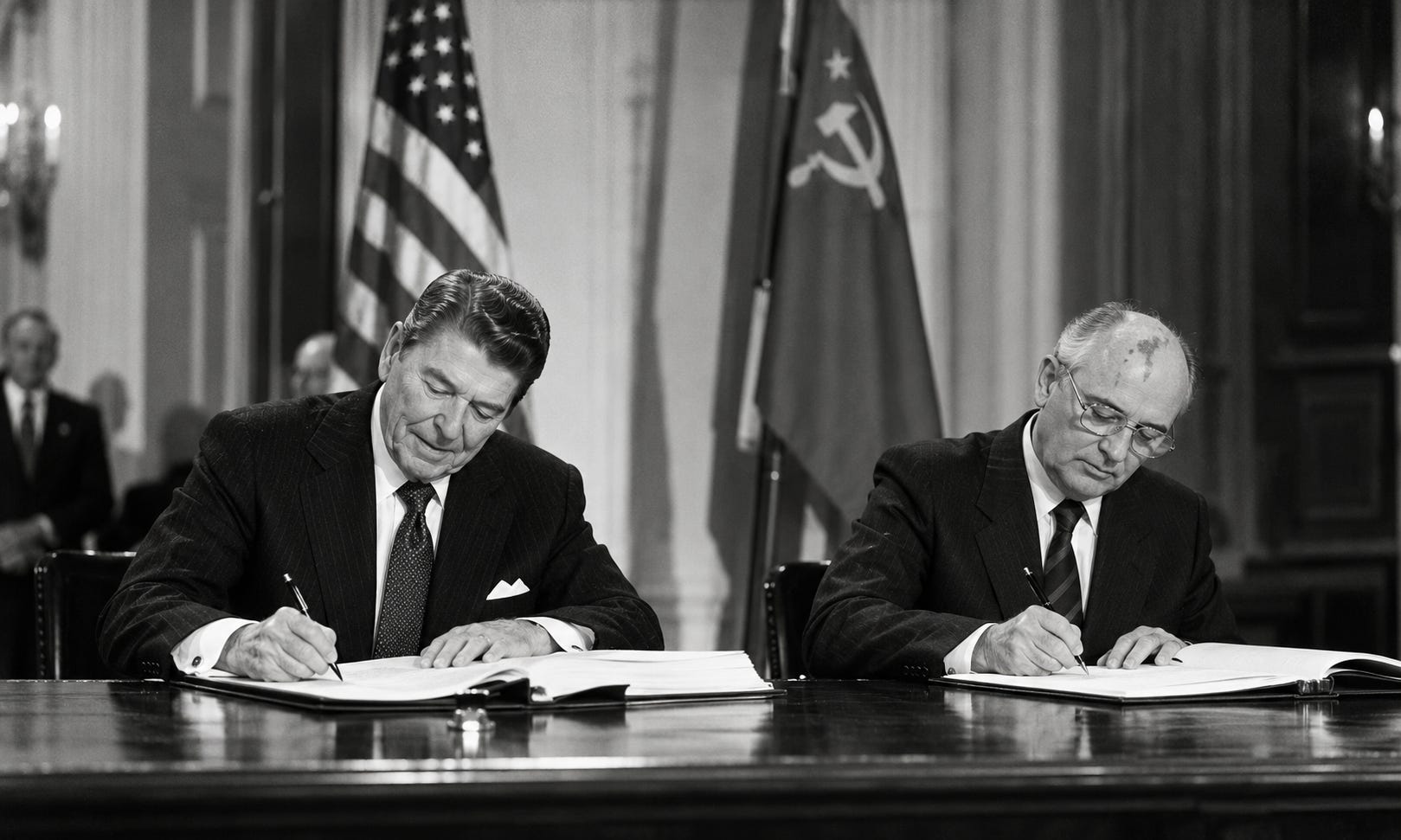
Schlafly and Goldwater helped create the political movement that made Ronald Reagan possible. Reagan has been elevated to sainthood, but I wonder how many Republicans would actually support him today. He was a pragmatist who negotiated with Democrats and with the Soviet Union. He signed a landmark nuclear arms treaty in 1987, even as some conservatives protested his willingness to deal with Moscow. Reagan was not after applause; he was motivated by higher moral principles. Reagan was dismissed by many establishment Republicans, as Goldwater, Schlafly and Teddy Roosevelt had been at different points in their careers. But they did not shrink from criticizing the Republican mainstream when the situation called for it—and it was soon that their opinions became the mainstream. All of these people understood that their obligation was to advance political ideas, not spout the party line. But today, it seems like independent thought is treated as disloyalty, compromise as surrender, and we are all supposed to act like we are at a goddamn pep rally rather than intelligent citizens in a republican democracy.
So, I am getting increasingly concerned about the way we Republicans are acting. Democracy is not sustained by elections, slogans, and winning the next round. It depends on our own individual insight, research, and serious participation. More importantly, it depends on moral habits such as self-restraint, association, faith, and, most importantly, a sense that we owe something to people other than ourselves. The moment every moral rule becomes negotiable depending upon whether it hurts our “team,” we have ceased participating in a democracy and started a mindless fan club.
Democrats have been a circus since the 1960s. They preach tolerance and act scandalized when someone dares to disagree with their constantly shifting dogma. But we Republicans cannot talk endlessly about Christianity and act like the Sermon on the Mount is optional for party members. Having principles means that we need to act when it is inconvenient.
So let’s get back to the original message. I love this country—which is why I refuse to pretend that everything we have ever done was righteous. The Indian wars were complicated, but there were many actions that we should not be proud of, nor try to justify. Maybe we don’t even know how to make amends, but acting like it never happened, or throwing up mindless justifications only diminishes our civilization. We have a lot to be repentant for, but when we lose the idea that we are sinners and imperfect, things do not go well for us. It was this desire to repent that brought about opposition to slavery, child labor laws, and civil rights legislation. When our politicians engage in acts of corruption, we should not excuse them on the basis of political party. If we do that, we are no better than the opposition. If we attack fellow conservatives and Republicans for having a different point of view—and possibly a visionary point of view—we are no better than those who try to enforce speech codes within the opposition.
In the end, we are all citizens, and we are neither merely Republican nor Democrat; we are all children of God. Wishing that we lived in a world where everyone thought the same and looked the same is not America, it is Hades. We cannot justify everything that happened in our country’s past, nor should we try. But we can be better. And acknowledging the truth of our past is what will help us build a better future.